Research journal · Announcement
Introducing Wake 5
Wake 5 fuzzes Solidity from one prompt: an agent writes the fuzz test, an auditor reviews it in Python, and an EVM inside the Python process runs it as fast as Foundry.
Wake 5, the open-source Python framework ack3’s auditors use to test, fuzz and statically analyse Solidity, is available today:
pip3 install eth-wakeThe release changes who writes the fuzz test. In manually guided fuzzing, auditors write the harness: the flows, a Python model of the contract’s state, and the invariants that must hold. In Wake 5 a coding agent writes that harness from one prompt, the auditor reviews it as ordinary Python, and Wake runs it at native speed. The prompt is in the Wake README.
What is new
- An EVM inside the Python process. The default engine is revm, bound to Python. No development node to start; live chains fork through
chain.connect(fork=...), and several chains run in one process for cross-chain tests. - An MCP server for agents.
wake mcpgives an agent the static facts the language server has: contracts, definitions and references, inheritance, storage layout, state changes, selectors, external calls. - Multi-hour campaigns stay memory-stable. Chain history is bounded to the newest 256 blocks by default.
- Generated Python types for every contract, so tests and agents get autocompletion and type checking against the Solidity code. Types generated by Wake 4 need regenerating; the migration guide lists every breaking change.
Measured in the preprint
The preprint Wake 5: A Python Framework for Solidity Testing, Fuzzing, and Static Analysis by Josef Gattermayer and Michal Převrátil describes the design and measures it on the five L32 mazes of the Daedaluzz benchmark: 153 reachable assertions behind guards built from constants.
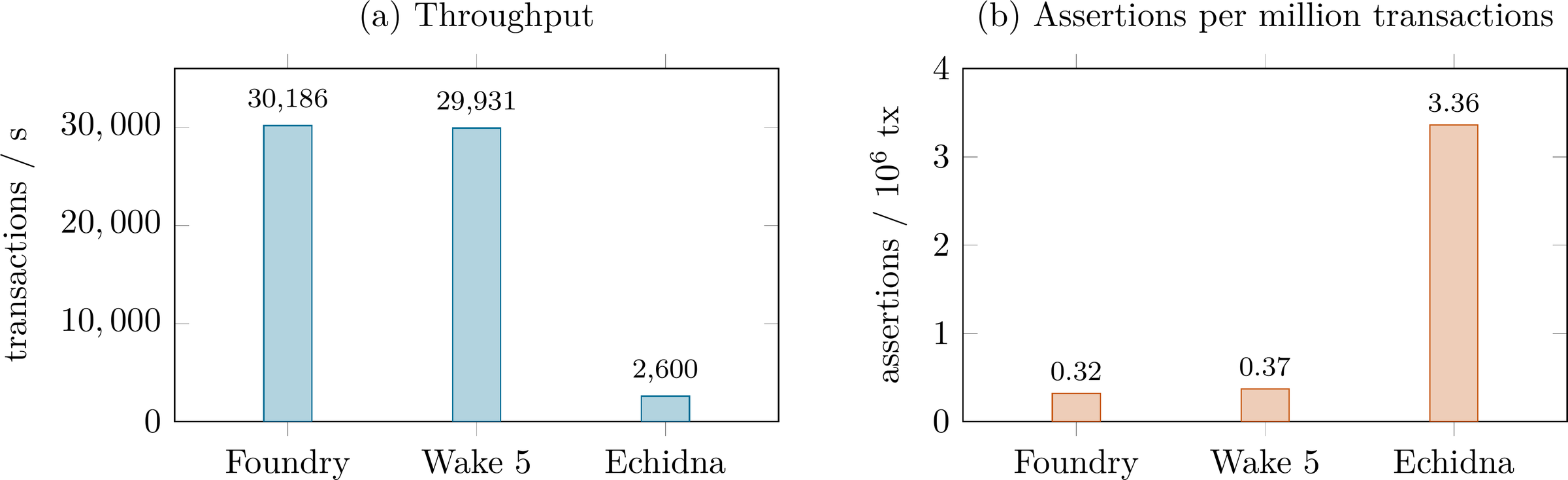
Wake 5 executes 29,931 transactions per second, against 30,186 for Foundry and 2,600 for Echidna. The two tools that embed revm run within one percent of each other, so a Python test framework no longer pays for its language in execution speed.
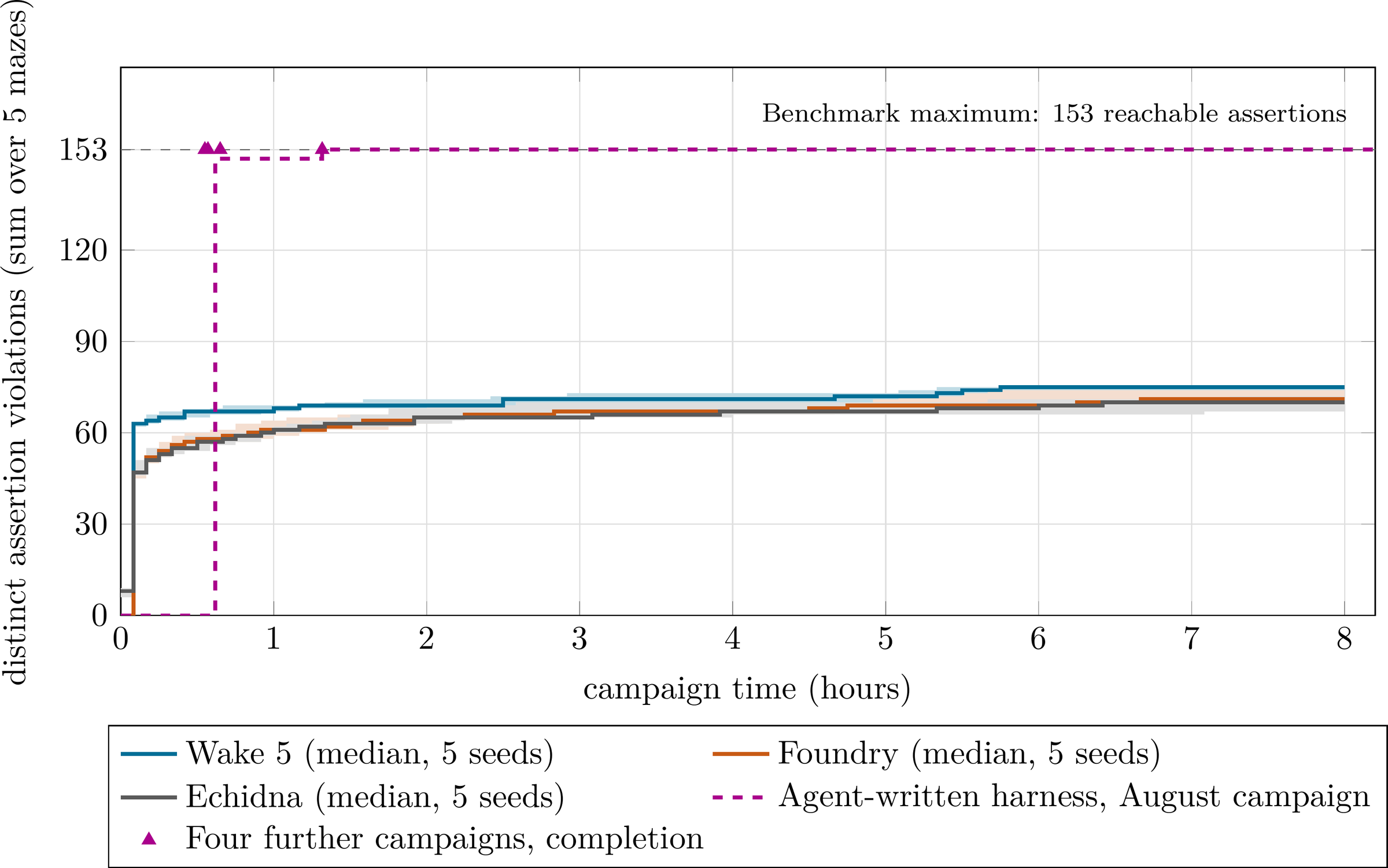
Throughput does not decide what random fuzzing finds on these mazes. After eight hours the three fuzzers reach 75, 71 and 70 of 153 assertions. A harness written by an agent, with the guards handed to a constraint solver and the routes planned through the parsed maze, reached all 153 in every one of five campaigns, in 33 to 79 minutes. The limit sits in the input generator, not the engine: Wake places half of its 64-bit draws below 2³², which helps on these small constants and loses its advantage when the constants span the full 64-bit range.
The preprint’s static-analysis ablation, where three models reviewed a production Go client with and without an eleven-tool MCP server, found precision up for all three models and recall improved for none: Static Analysis MCP Tools in an AI Audit Benchmark. On real protocols, agent-written tests reached the known recall of hand-written harnesses and still missed the one scenario a known bug needed: Evaluating Agent-Written Fuzz Tests.
Availability
Wake is open source under the ISC licence at github.com/ack3-ai/wake, with documentation at ack3.ai/wake/docs. The preprint is on arXiv under CC BY 4.0: arXiv:2611.09307. Benchmark code and campaign data are at github.com/ack3-ai/daedaluzz-benchmark.
Contributors
About the authors.
Vocabulary
Terms used in this article.
-
Wake
An open-source Python framework for testing, fuzzing, and statically analysing Solidity, developed by ack3; tests and fuzz harnesses are Python.
-
Wake 5
The 2026 major release of Wake: an EVM inside the Python process, an MCP server for agents, and fuzz tests a coding agent writes from one prompt.
-
Echidna
Echidna is an open-source Ethereum smart contract fuzzer that generates call sequences to falsify user-defined properties and Solidity assertions.
-
Fuzz testing
Automated testing that explores many generated inputs or action sequences to find violations of expected properties.
-
Auditor
A smart contract auditor is a security researcher who reviews blockchain systems for exploitable behavior, unsafe assumptions, and implementation errors.
-
Invariant
A property that must remain true before and after every relevant state transition in a system.
Continue reading
Related research.
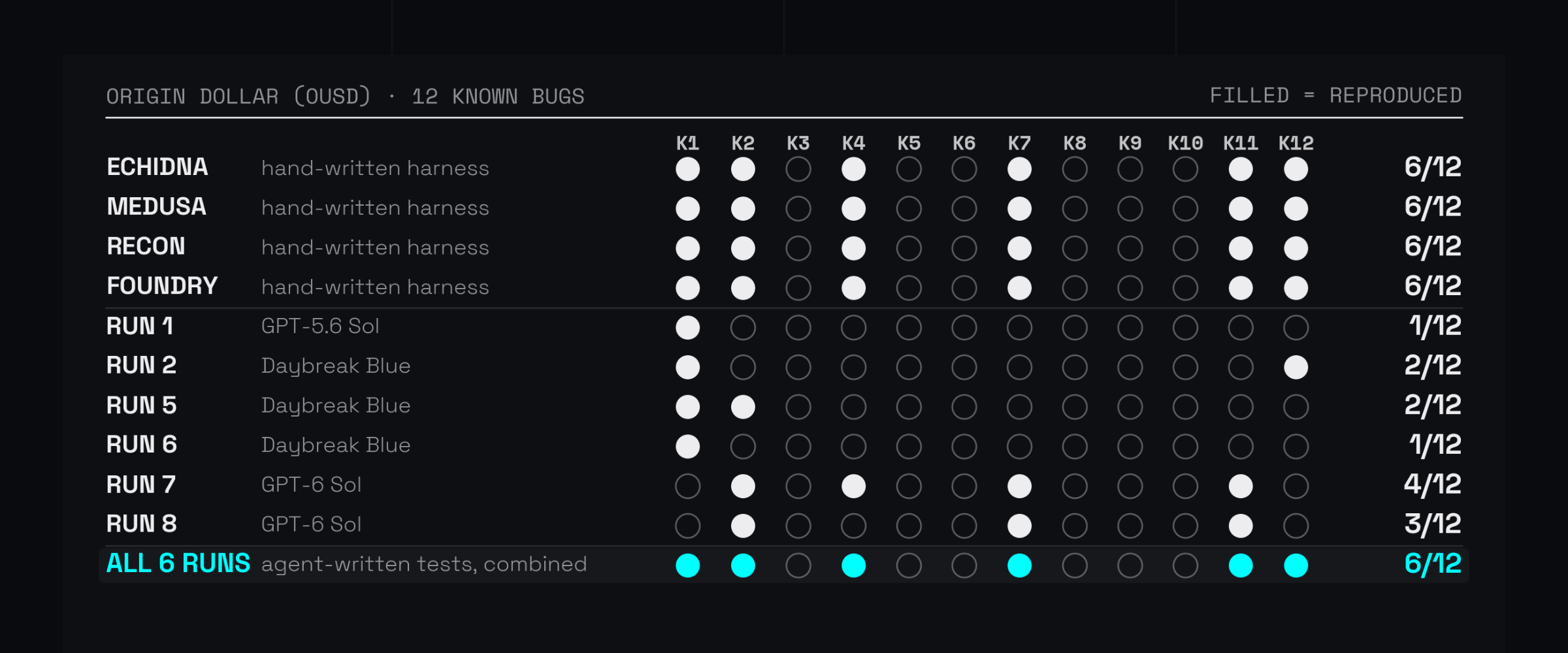
Can a coding agent do the harness-writing work of manually guided fuzzing on a real protocol? Measured on two DeFi protocols with known, human-triaged bugs.
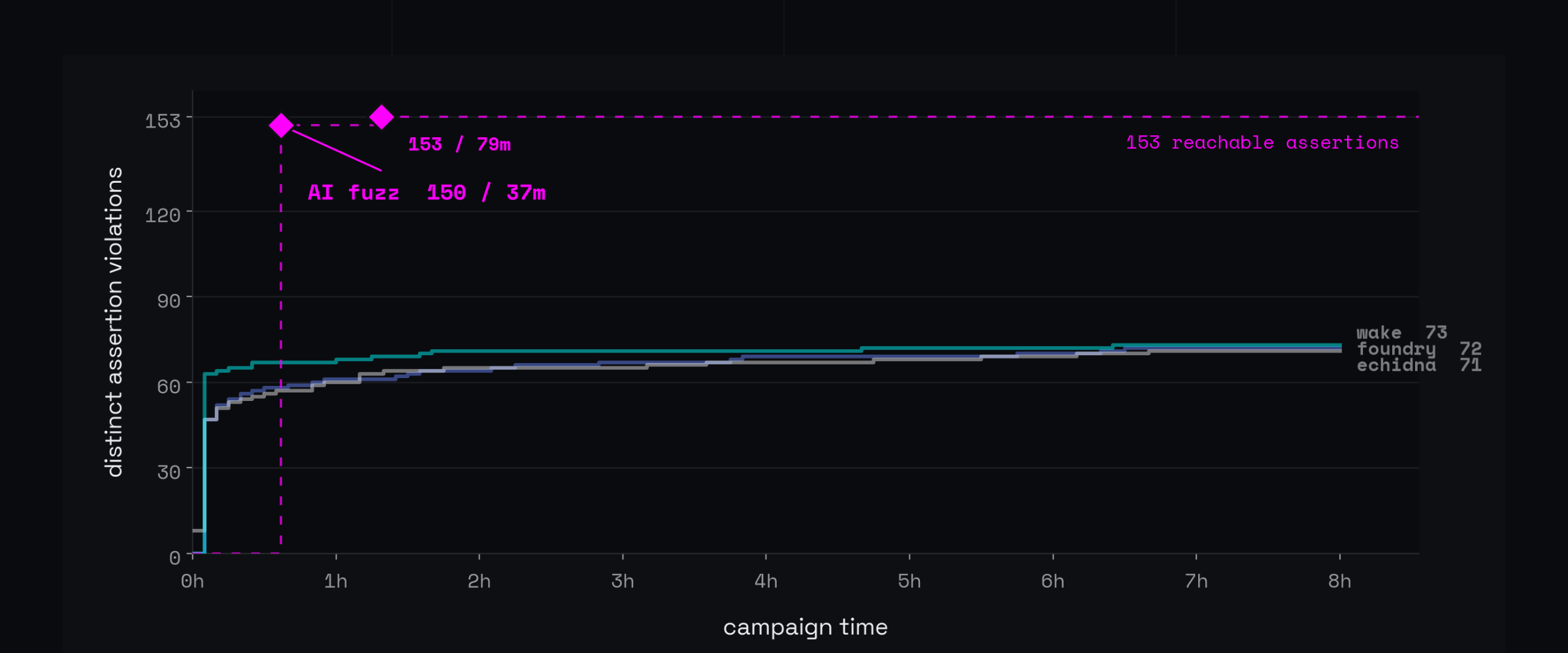
Three EVM fuzzers ran eight hours per maze against 153 reachable Daedaluzz assertions; an agent-written harness ran once. The deciding variable was not speed.
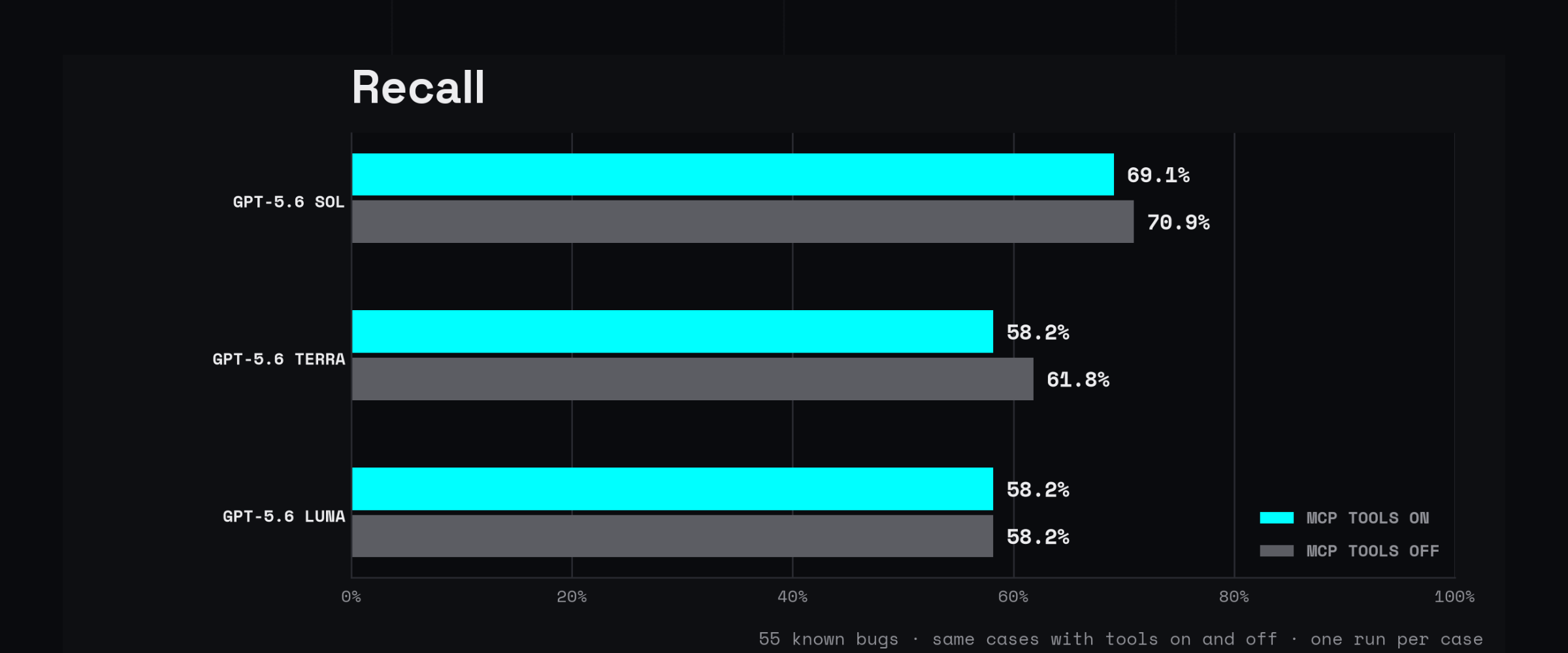
Can deterministic static-analysis MCP tools improve audit results from non-deterministic AI? Three GPT-5.6 models reviewed the same Go codebase with and without them.
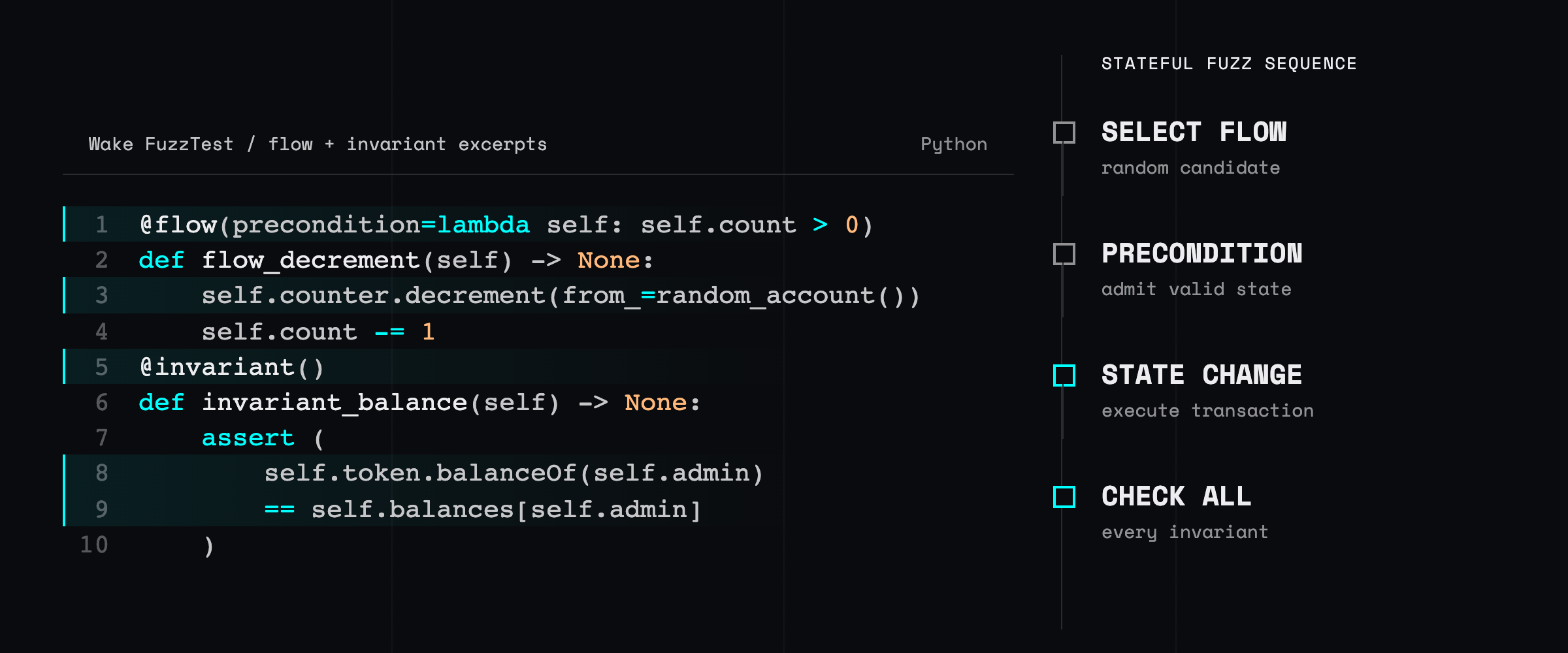
Learn how manually guided fuzzing combines stateful, white-box testing with flows and invariants to test complex smart contracts more efficiently.